 Trip Plan Viewer
Take a look at the clear bin next to the X-ray trays at security. It's filled with the same handful of items, over and over: water bottles, lotion bottles over 100ml, a multi-tool from someone's hiking bag. Everyone packs for their own trip in their own way, and yet what ends up confiscated is strikingly repetitive. Once you understand why, you can scan your own bag before you ever get to the checkpoint.
Why Items Get Flagged — Think in Categories of Risk
Rather than memorizing a list, it's more useful to understand carry-on restrictions as three categories of risk. That way, when you run into an ambiguous item that isn't on any list, you can still reason it out yourself.
- Fire or explosion risk — pressurized canisters or flammable substances like butane, spray cans, lighter fuel
- Potential weapons — anything with a blade, a sharp point, or enough heft to be used as a blunt object
- Liquid explosive concerns — liquids and gels in general, since they're hard to individually verify
If an item doesn't fall into one of these three categories, it's generally fine to carry on. If it does, it either goes in checked baggage or gets left behind entirely.
Liquids, Gels, and Aerosols — The 100ml Trap
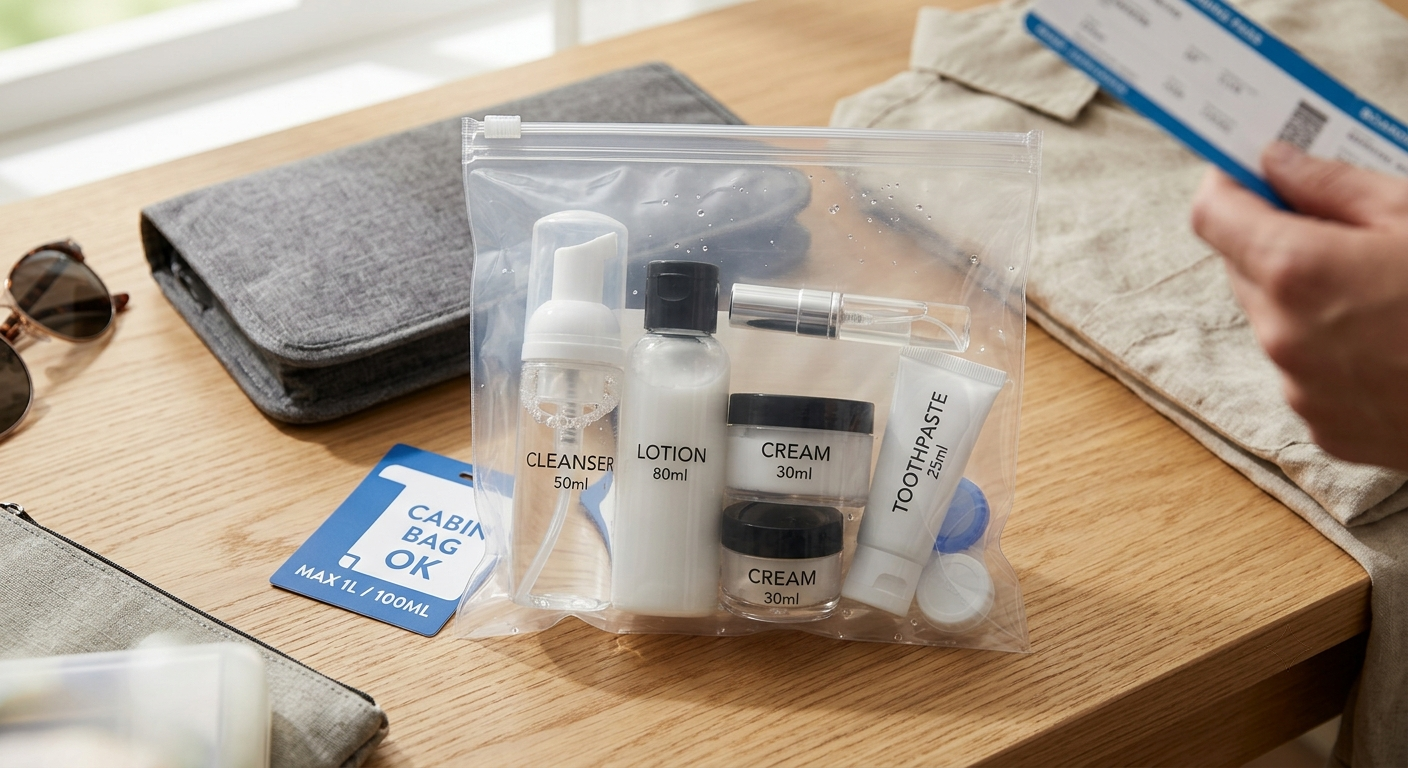
On international flights, each container must hold 100ml or less, and everything together has to fit into a single 1-liter clear resealable bag per person (sized 20.5×20.5cm or 15×25cm). Here's where most people get tripped up: the rule is based on the container's printed capacity, not how much liquid is actually left inside it. Even if a 300ml bottle only has 50ml of lotion left in it, the bottle itself is a 300ml container, and that alone is enough to get it flagged. Decant into a smaller bottle and it'll pass.
There are exceptions. Duty-free liquids sealed unopened in a tamper-evident bag (STEB) are allowed regardless of volume. Medication and baby food can sometimes exceed 100ml with justification, so it's worth confirming with your airline or the airport before you fly. And if you're on a domestic flight, none of this applies — domestic liquids have no volume restriction at all.
Power Banks and E-Cigarettes — Why They Can Never Be Checked
Lithium batteries carry a thermal runaway risk — if damaged, they can heat up and ignite on their own — which is exactly why they're banned from the cargo hold, a space where no one can respond immediately if something goes wrong. That's why power banks can never go in checked baggage and must always be carried on board. Batteries at 100Wh or below are generally allowed with no limit on quantity; batteries between 100–160Wh require airline approval and are capped at two per person; anything over 160Wh is prohibited outright. Terminals also need to be insulated so they can't short out against another metal object.
E-cigarettes and lighters follow the same logic and are also banned from checked baggage, but the finer details — quantity limits, e-liquid volume caps — vary enough by airline that we won't state specific numbers here. Check your airline's official guidance before you travel.
Blades and Tools — Not in the Cabin, Fine in Checked Baggage
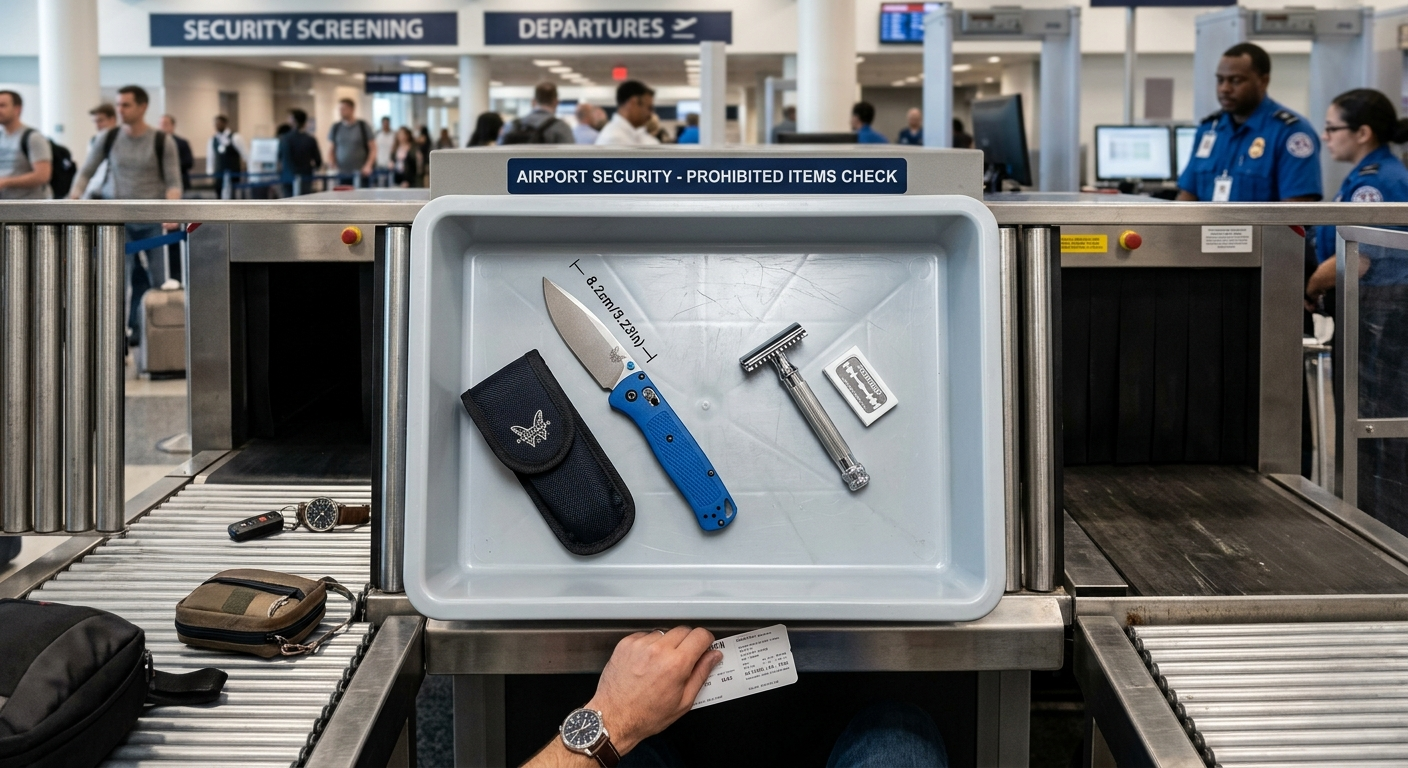
Sharp tools like paring knives, hunting knives, and multi-tools with blades aren't allowed in carry-ons, but they check through without issue in your checked bag. On the flip side, round-edged butter knives and safety razors are allowed on board, since they're not considered practical as weapons.
The items people most often get wrong are the ones that sit ambiguously on that line — a nail file attached to clippers, scissors, the pointed legs of a tripod. Whether these pass often comes down to blade length or shape, and we won't state a specific length threshold here since it varies. If you're unsure, packing it in checked baggage is the safer bet and saves you time at the checkpoint.
Items Banned From Both Carry-On and Checked Baggage
Flammable gases and liquids, along with radioactive materials, are considered too high-risk for either the cabin or the cargo hold. Camping butane canisters are the classic example. This is the one category where there's no workaround of splitting items between bags — buying a replacement at your destination is really the only option.
At-a-Glance: What's Allowed Where
| Item | Carry-On | Checked | Fully Banned | Note |
|---|---|---|---|---|
| Bottled water, 500ml (sealed) | ✕ | ○ | Liquids over 100ml aren't allowed in the cabin | |
| Small cosmetics (30ml) | ○ | ○ | Must comply with the resealable-bag rule | |
| Perfume, 100ml | ○ | ○ | Container must be printed as 100ml or less | |
| Duty-free alcohol (sealed STEB) | ○ | ○ | Only while unopened | |
| Power bank (~74Wh) | ○ | ✕ | Never allowed in checked baggage | |
| High-capacity power bank (100–160Wh) | △ | ✕ | Requires airline approval, max 2 per person | |
| Paring/hunting knife | ✕ | ○ | ||
| Safety razor | ○ | ○ | Round blades are the exception | |
| Butter knife (round blade) | ○ | ○ | ||
| Nail clippers (with file) | △ | ○ | Depends on shape; check official guidance | |
| Scissors | △ | ○ | Blade-length rules vary; check official guidance | |
| Butane canister | ✕ | Banned from both carry-on and checked | ||
| Lighter | △ | ✕ | Quantity limits apply; check official guidance |
How to Move Through Security Faster
Keep your resealable liquids bag near the top of your carry-on, somewhere easy to reach. Digging through a bag at the checkpoint is one of the biggest sources of delay. Put your laptop and tablet in a separate tray, and empty your pockets of coins and take off your belt in advance to avoid a second pass through the scanner. Power banks and e-cigarettes are best kept somewhere easily accessible, like an outer pocket, rather than buried inside the bag.
Frequently Asked Questions
How many toiletry containers can I bring in my carry-on?
The real limit isn't a count of containers — it's that everything has to fit inside a single 1-liter resealable bag. Volume is what matters, not the number of bottles.
Can I bring an empty water bottle through security?
Yes. An empty container isn't a liquid, so it's not subject to the restriction. Fill it up at a water fountain after you clear security.
Can I bring more than 100ml of medication?
Medication sometimes qualifies for an exception with proper justification. Bring your prescription or a doctor's note, and confirm the exact process with your airline in advance.
Do domestic flights follow the same liquid rules?
No, domestic flights have no volume limit on liquids. That said, if you're connecting to an international flight, the international rules may apply to that leg.
Most confiscated items aren't a result of not knowing the rules — they're a result of forgetting. A lotion bought a few days earlier, still sitting in the suitcase. A leftover camping gas canister no one thought to check for. Keeping your packing list on the same screen as your itinerary means you catch these items again right when you're packing. Organizing your itinerary and packing checklist together in TripPlanViewer is one way to make that happen.
Source: Incheon International Airport prohibited items guide, https://www.airport.kr/ap_ko/906/subview.do