 Trip Plan Viewer
The moment your suitcase hits the check-in scale, the number flashes red. There's a long line behind you, and the agent pulls out the overweight fee chart. A few hours later at the security checkpoint, your bag gets opened again, and a 300ml bottle of lotion goes into the confiscation tray. Neither moment was something you saw coming the night before, while you were packing. Baggage rules are the kind of thing you learn too late — at the airport — and they vary just enough by airline that searching online only adds to the confusion. This guide lays out what you can actually check before you zip the suitcase shut.
One Question That Sorts Most of Your Luggage
When you're deciding what goes in checked baggage and what you carry on, you don't need to memorize every regulation — just ask two questions. First: "Would this trip fall apart if I lost this item?" Checked baggage carries a real risk of loss, damage, or delay. Passports, essential medication, laptops and cameras, cash, and valuables always go in your carry-on. Second: "Is this a hazardous item?" Anything with fire risk, like a power bank, must go in the cabin; sharp items like knives or scissors go in checked baggage or get left behind entirely. Those two questions alone sort about 80% of your packing. The rest just comes down to knowing the specifics. (Source: Incheon International Airport prohibited items guide, https://www.airport.kr/ap_ko/906/subview.do)
Checked Baggage: Size Is Standard, Weight Depends on the Airline
The size limit for checked bags is fairly clear-cut: the sum of the three dimensions (length + width + height) can't exceed 158cm (62 inches), and this applies across most airlines on both domestic and international routes. The free checked-weight allowance, on the other hand, varies significantly by airline, route, and cabin class, so there's no single kg figure that applies universally. Always confirm this through the baggage information on your ticket or the airline's official website.
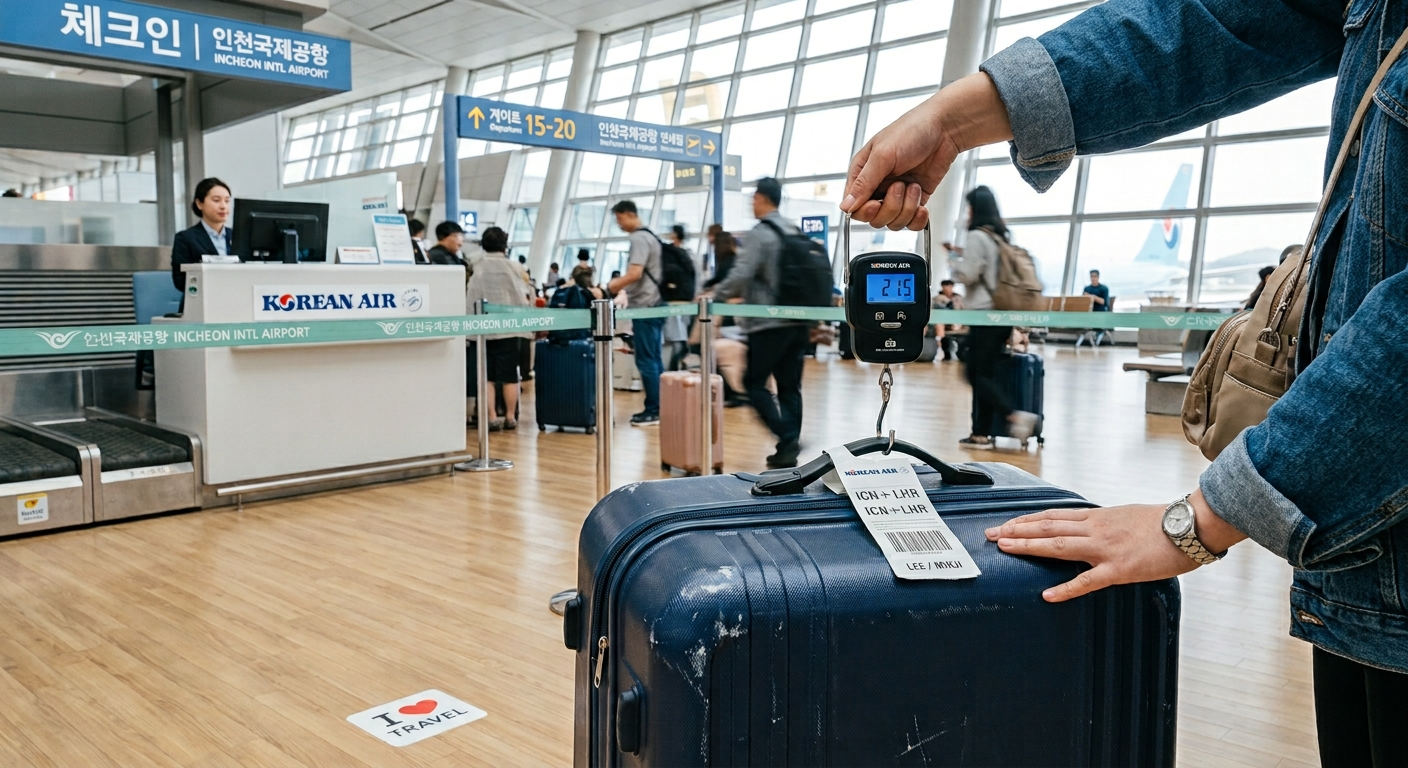
If your bag is overweight at the counter, you'll typically either pay an overage fee on the spot or have to reopen your suitcase and shift items into your carry-on. Both options cost time and put you on display for everyone waiting behind you. The most reliable way to avoid this is to weigh your bag at home beforehand. A hanging luggage scale is small and cheap — hook it onto the suitcase handle as the last step of packing, and you'll rarely be surprised at the counter again.
Carry-On Baggage: 100ml Containers, One 1-Liter Bag
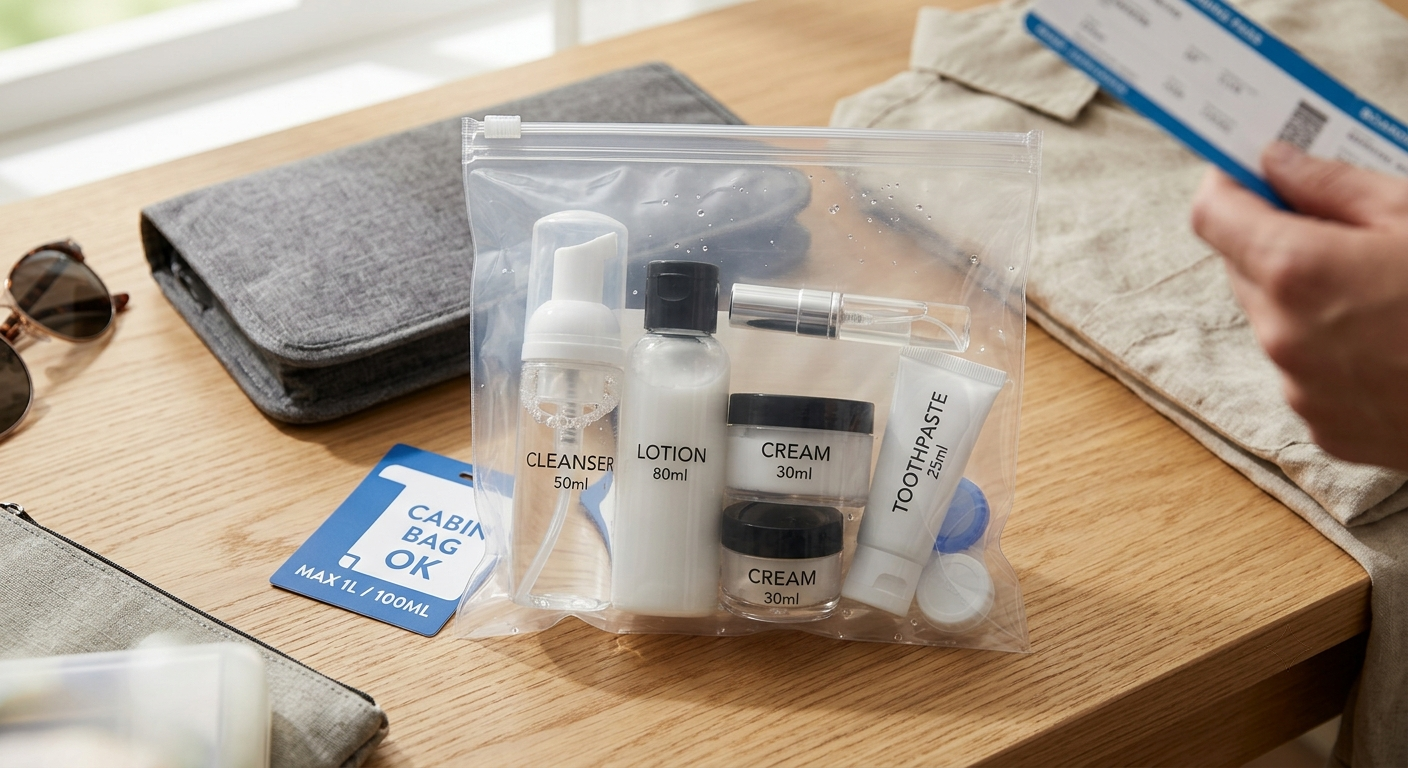
On international flights, liquids, gels, and sprays can only be carried on in individual containers of 100ml or less, and all of them together must fit into a single 1-liter clear resealable bag per person (sized 20.5×20.5cm or 15×25cm). There's a common misunderstanding here worth clearing up: the limit is based on the container's capacity, not how much liquid is actually left inside. A 500ml bottle with only 50ml of liquid remaining still won't pass. On the flip side, duty-free liquids sealed unopened in a tamper-evident bag (STEB) are allowed regardless of volume. If your itinerary includes a connecting flight, be careful not to break that seal. Domestic flights, by contrast, have no liquid restrictions at all.
Power Banks: Never in Checked Baggage — Calculate the Watt-Hours Yourself
Power banks are the rule people get wrong most often. Lithium batteries can never go in checked baggage — they must always be carried on board. Every flight has someone who checks their suitcase, only to realize afterward they forgot their power bank and has to reopen their bag. There are capacity limits too: batteries at 100Wh or below are generally allowed with no limit on quantity; batteries between 100–160Wh require airline approval and are capped at two per person; anything over 160Wh is prohibited outright. It's also good practice to insulate the terminals with tape or a pouch.
The catch is that most power banks only print mAh on the casing, not Wh. You can convert it yourself. The formula is Wh = mAh ÷ 1000 × V, and most power banks run on 3.7V. A 20,000mAh unit works out to 20 × 3.7 = 74Wh, which falls under the 100Wh threshold and is generally allowed. A 30,000mAh unit comes to 30 × 3.7 = 111Wh, which lands in the airline-approval range. Do this calculation once from the number on the back of your battery, and you won't need to argue about it at the airport.
Mistakes People Actually Make
- Packing power banks or spare batteries in checked luggage, then having to pull them back out during screening
- Assuming a liquid container is fine because it's not "over 100ml" of liquid, not realizing the limit is based on the container's capacity
- Trying to carry on a tripod or selfie stick and getting stopped over sharp metal components
- Tossing fruit or processed meat bought at the destination into a bag without thinking, then getting flagged at customs/quarantine
- Packing flammable spray cans over the 500ml-per-container limit, exceeding the checked-baggage threshold
- Having duty-free liquids that cleared security on departure get confiscated during a re-screening at a connecting airport
Item-by-Item Rules at a Glance
| Item Type | Carry-On | Checked | Notes |
|---|---|---|---|
| Power banks/spare batteries | Allowed (capacity-dependent) | Prohibited | 100Wh or below generally allowed |
| Liquids ≤100ml (in resealable bag) | Allowed | Allowed | One 1-liter bag per person |
| Duty-free liquids (sealed STEB) | Allowed | Allowed | No volume limit |
| Flammable sprays | Not allowed | Allowed (2kg/2L total) | 500g/500ml per container |
| Knives, scissors, sharp objects | Not allowed | Allowed | Round-tip butter knives and safety razors allowed on board |
| Flammable gas/liquid, radioactive material | Prohibited | Prohibited | Banned across the board |
Pre-Packing Checklist
Frequently Asked Questions
What happens if I forget and pack a power bank in checked luggage?
If it's caught during screening, the bag has to be reopened and the battery removed before you can proceed through check-in. If you're running short on time, the worst case is having to abandon the battery entirely — it's safer to set it aside during packing.
What if my checked bag exceeds both the size and weight limits?
You'll typically be offered the option to pay an overage fee at the counter, or reopen the bag and move some items into your carry-on. Fees vary by airline, so check the exact amount through your airline's official information.
Does the 100ml liquid rule apply on domestic flights too?
No. Domestic flights have no liquid restrictions at all. That said, if your itinerary includes an international connection, the international rules apply, so don't mix the two up.
What should I do if my power bank exceeds 100Wh?
Batteries in the 100–160Wh range can be carried on with prior airline approval, up to two per person. Anything over 160Wh is prohibited outright, so check with your airline about the approval process before you travel.
Final Thoughts
Once you've sorted out baggage rules, you can reuse the same checklist on your next trip. The real question is where you keep it. If your flight details, hotel bookings, and packing checklist are scattered across different note apps, you'll end up searching for all of it again the night before departure. Keeping your itinerary and packing list together in one place — the way TripPlanViewer does — means your checklist stays part of your trip plan, easy to find again next time.