 Trip Plan Viewer
"Let's spend around ₩1,000,000 on this trip." A budget set like that is usually already blown by the halfway point. The reason is simple: flights and accommodation are fixed amounts, paid before you even leave. What actually breaks a budget is the cost that resets every day — food, local transport, shopping. With only a total in mind, you have no way to see how fast that variable spending is draining away, and no baseline for how much you should be spending per remaining day. When a budget exists as one number with no categories, the moment you discover you've overspent is always after the trip, staring at a credit card statement.
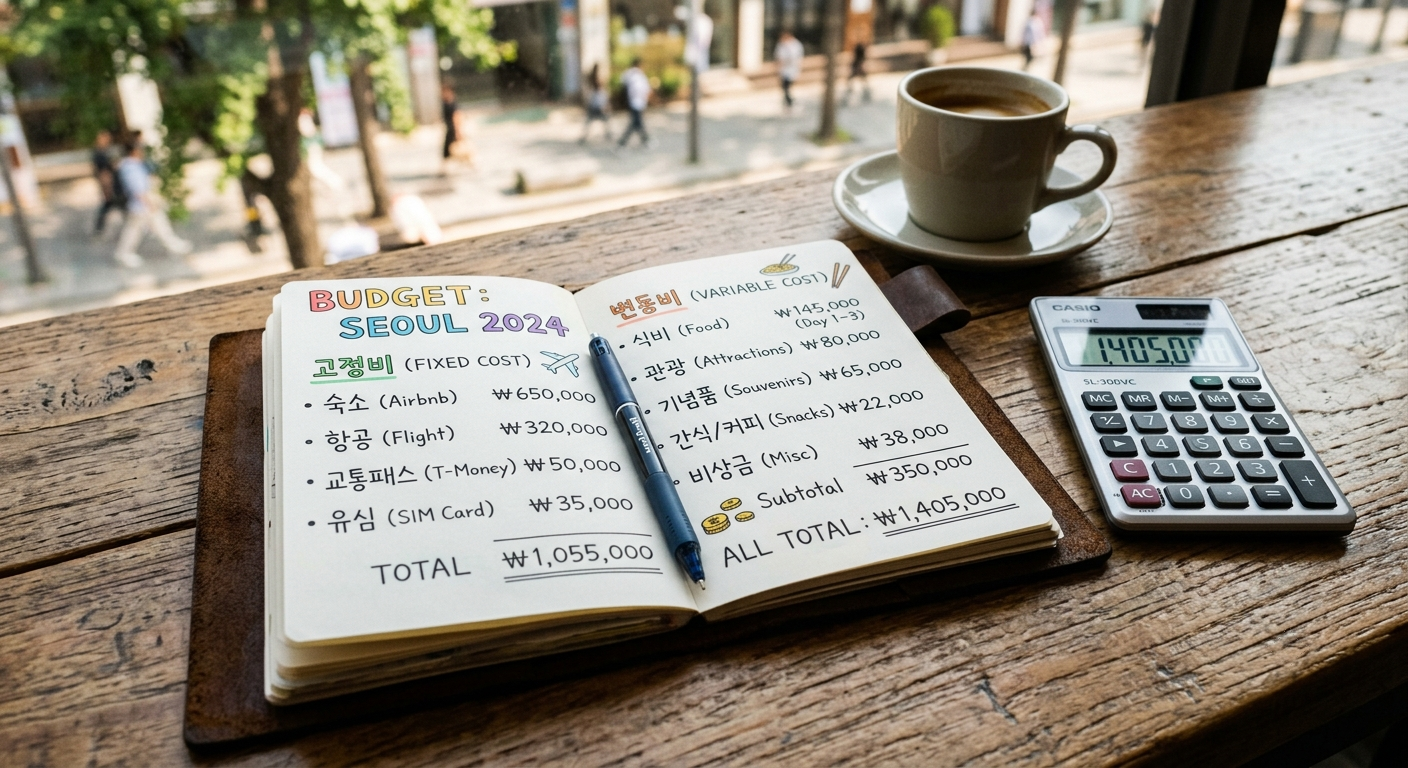
Split fixed costs from variable costs first
The first step in budgeting isn't dividing up an amount — it's dividing up the nature of the spending.
- Fixed costs: Flights, accommodation, pre-booked tickets or tours — anything whose amount is locked in before departure. This is the anchor for the entire budget.
- Variable costs: Food, local transportation, shopping, contingency funds — anything that happens in real time during the trip. This is the only category that actually needs active management.
Once fixed costs are booked, the math on them is done. Once you accept that the only thing you actually need to manage is variable spending — not the whole trip total — the scope of what you're tracking shrinks by more than half.
A starting framework for category allocation
There's no single correct answer, but you need a starting point to adjust from. The percentages below aren't statistics — they're a template to start from and adjust to your own travel style.
| Category | Domestic 2N3D example | International 4N5D example |
|---|---|---|
| Flights/transportation (fixed) | 15% | 35% |
| Accommodation (fixed) | 30% | 25% |
| Food | 25% | 15% |
| Local transportation | 10% | 8% |
| Shopping | 10% | 7% |
| Contingency | 10% | 10% |
International trips carry a heavier flight cost, which naturally shrinks the share left for food and shopping; domestic trips carry lighter fixed costs, leaving more room for food and local activities. If you barely shop, shift that percentage into contingency or food instead.
Always keep contingency as its own separate line
Keep contingency separate from food or shopping, rather than folding it in, so that when another category runs over, the overage gets absorbed by the contingency fund instead of quietly eating into something else. Keeping it separate is what lets you clearly see, after the trip, exactly which category you underestimated. Mix it all together, and all you know is whether the total was right or wrong — never why.
The reason to set contingency around 10% is that any higher and your other allocations get too loose; any lower and it can't absorb surprise costs from exchange rate swings or local conditions (a sudden spike in taxi fares during a rainstorm, for example). If contingency money is left over at the end of the trip, don't just spend it — decide deliberately whether to roll it into the next trip's budget or treat it as free spending money on the last day.
Breaking it down by day is what actually keeps you in control
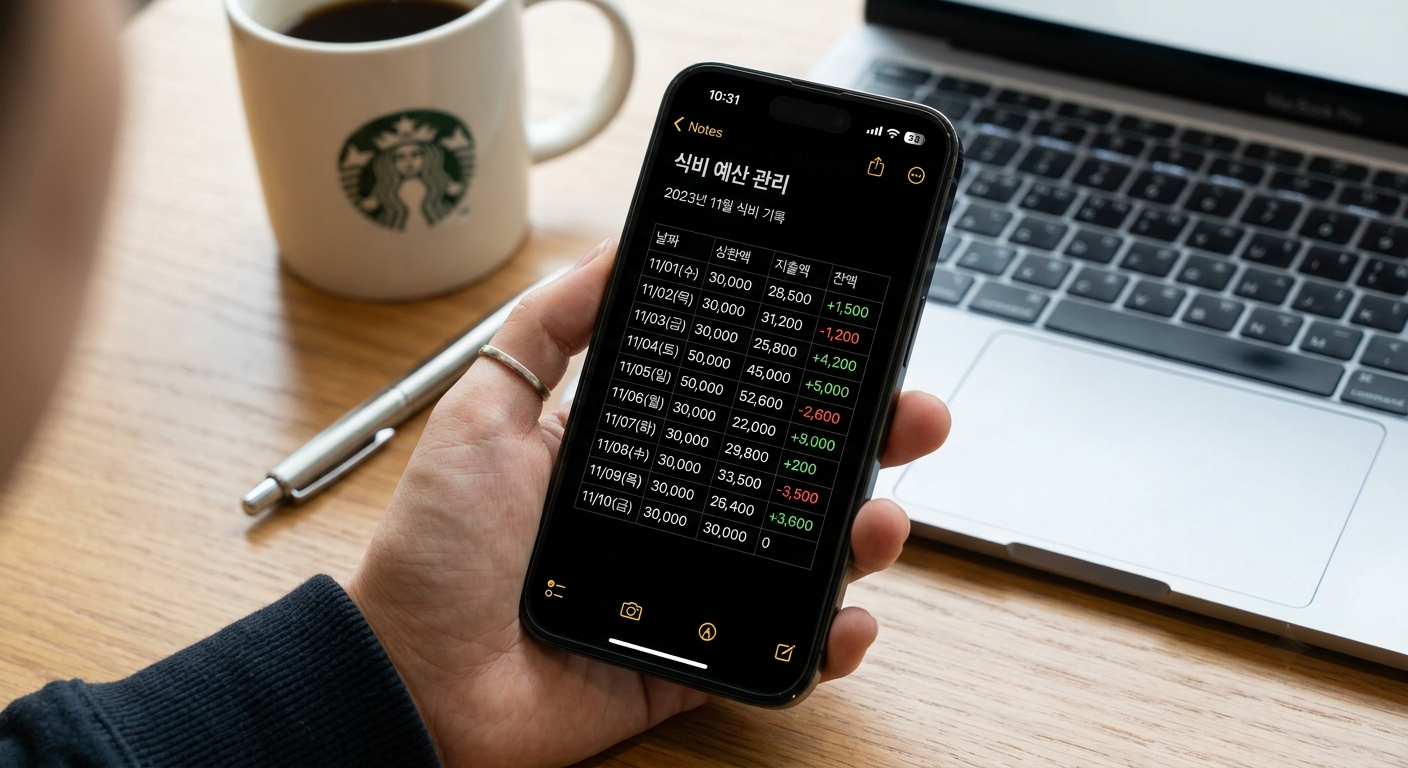
Neither a total nor category subtotals tell you how much you can spend today. Only a daily cap does that.
For example, if your total food budget for a four-day trip is ₩300,000, that's ₩300,000 ÷ 4 days = a ₩75,000 daily cap. Split between two people, that's ₩37,500 per person per day. Check that number every morning, and if you spend big on dinner the first night, you immediately see the remaining days' caps shrink automatically. With only the total in view, that adjustment stays invisible — and you only discover the overage on the last day.
Cash vs. card: a practical rule of thumb
The deciding factor for your cash-to-card ratio is simple: how often will you run into places that don't take cards? In destinations where you'll frequently need small amounts of cash — traditional markets, small restaurants, tips, restroom or luggage storage fees — lean more toward cash. In places with strong card infrastructure, you can lean more toward card.
When paying by card abroad, always pay in the local currency. If a payment terminal or online checkout asks "Would you like to pay in your home currency?", the rule is to decline. This is called DCC (Dynamic Currency Conversion), and it stacks two separate currency conversions — one from the merchant, one from your card issuer — layering an unfavorable margin on top of an unfavorable margin. Paying in local currency eliminates that double-conversion step entirely.
Where budgets fall apart on group trips
If you're traveling with others, separate shared expenses from personal ones before you even leave. If costs like accommodation, which get split, get tangled up with things like souvenirs, which don't, by the end of the trip settling up becomes complicated on top of an already complicated budget. (Splitting the bill itself is a big enough topic that it's covered in a separate article.)
5 practical tips to avoid going over budget
- Deliberately spend less than your daily cap on the first night's dinner — the start of a trip is when excitement runs highest and overspending is most likely.
- Log the amount in a notes app the moment you pay — reconstruct it later and small purchases get missed.
- Check your contingency balance every day — lower tomorrow's cap before the balance goes negative, not after.
- Withdraw your shopping budget in cash up front and carry only that amount — a card limit doesn't create the same psychological brake.
- Deliberately leave extra room in your last-day budget — airport duty-free and the final meal always run bigger than planned.
Pre-departure budget checklist
| Item to confirm | Check |
|---|---|
| Fixed costs (flights, accommodation, pre-bookings) finalized | [ ] |
| Variable cost categories allocated | [ ] |
| Contingency calculated separately | [ ] |
| Daily cap calculated (variable costs ÷ days) | [ ] |
| Cash/card ratio decided | [ ] |
| Shared vs. personal expenses separated (if traveling with others) | [ ] |
Frequently Asked Questions
Does my contingency fund have to be in cash?
No. Contingency is a budget concept, not a cash-versus-card distinction. You can keep it within your card limit and simply tag it as "this came out of contingency" at the moment you spend it.
Can I change the category allocation percentages mid-trip?
Yes. Just make sure that if you increase one category, you cut the same amount from another category or from contingency to keep the total intact. The allocation isn't a fixed rule — it's just a tool for calculating your daily cap.
How much are international card transaction fees?
This varies by card issuer and product, so this article won't state a specific number. Check your card issuer's foreign transaction fee policy directly for an accurate figure.
What do I do on a day I go over my daily cap?
Spread the overage across your remaining days and lower each day's cap accordingly. For example, if you went ₩20,000 over a ₩75,000 daily cap, cutting about ₩6,700 from each of the remaining three days brings the total back in line.
When your budget and itinerary live in separate places, you have to mentally connect "what day is it" with "what's today's cap" every single time. With something like TripPlanViewer, where your budget and schedule sit on the same screen, just looking at today's date shows you today's cap immediately — no separate calculation required.